

How Many Saline Removal Sessions Are Needed? Setting Realistic Expectations
If you are giving a client an exact session count before you have seen how their skin and pigment respond, you may be promising something the skin has not told you yet.
So, how many saline removal sessions are needed?
The honest answer is that it is impossible to predict an exact number. We often see amazing lightening after just one or two sessions. Other procedures may need four, five, or even six sessions to reach the desired lightening result.
That range can feel frustrating when your client wants a clear answer. But removal is not a procedure where every brow responds the same way. You are working with unknown pigment, unknown depth, different levels of saturation, different skin types, and a body that will heal in its own way.
Your job is not to promise a number. Your job is to assess what is in front of you, explain the variables, and help your client understand that removal is a process.
One session or five sessions can both be successful
One of the best ways to understand this is to look at healed results.
Li-FT technician Gabrielle Rock performed saline lightening procedures on several clients with similar skin types and what appeared to be dark, challenging brows. She used the same system and techniques, yet the number of sessions needed varied from client to client.
One client achieved a beautiful healed result after only one session.
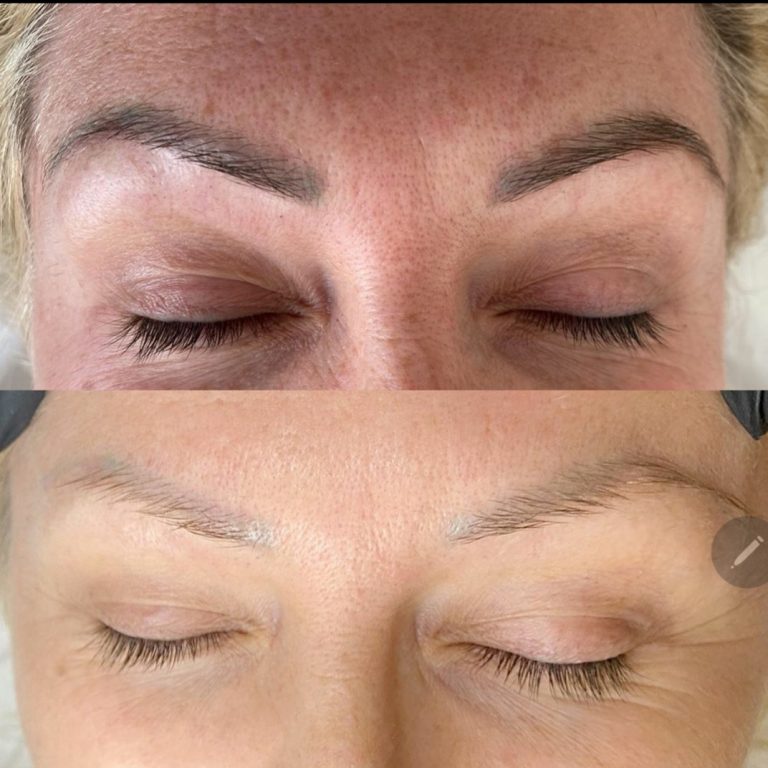
Healed eyebrow lightening after one Li-FT session. Procedure performed by Gabrielle Rock.
Another client needed five sessions to reach her healed result.
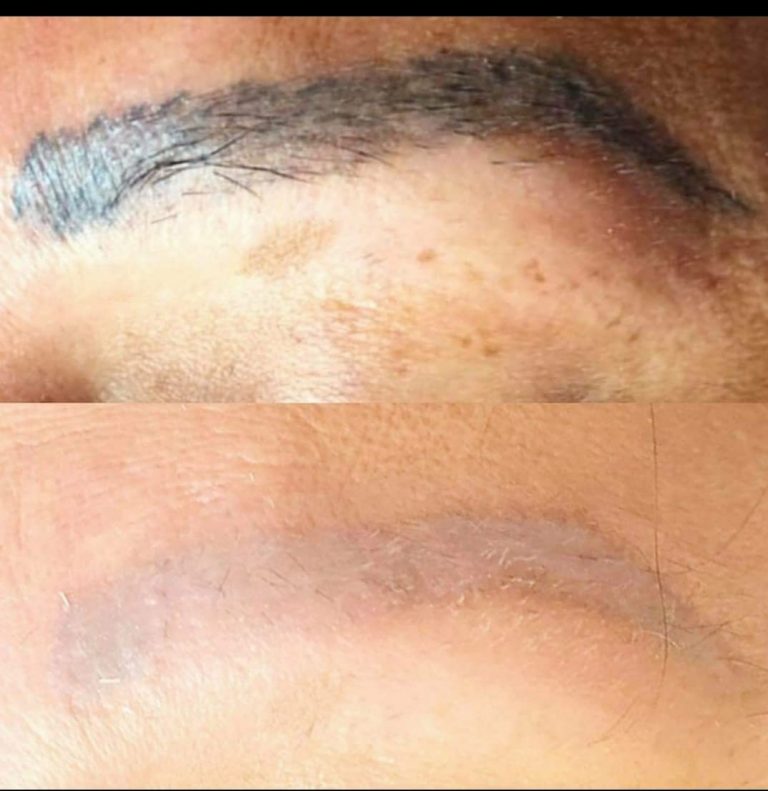
Healed eyebrow lightening after five Li-FT sessions. Procedure performed by Gabrielle Rock.
Both were successful outcomes. One was simply a much longer process.
That does not mean the technician did something differently or that the client who needed five sessions had a failed result. It shows exactly why you cannot look at a set of dark brows and know how quickly they will lighten.
The complete Li-FT Saline Lightening Course includes additional two-, three-, and four-session case studies that help you see just how different the process can look from one client to another.
What determines how many saline removal sessions are needed?
The color you see is only one part of the case. You also need to think about what may be underneath it, how it was implanted, and what the client’s skin and body will contribute to the healing process.
How many layers of pigment are present?
Ask how many times the area has been tattooed.
A client may call every appointment a touch-up, but repeated touch-ups can create layer after layer of pigment. The more pigment sitting in the skin, the longer the lightening process may take.
This is why the client’s procedure history matters. A brow that has been tattooed once is not the same case as a brow that has been refreshed every year for six years.
Is titanium dioxide present?
Titanium dioxide can prolong the lightening process.
You may not know exactly which pigments were used, especially when the client has seen multiple artists. However, previous color choices and correction work may give you clues that titanium could be present.
This is one of those situations where patience becomes especially important. You cannot force the skin to give you more than it safely can during one session.
How deeply was the pigment implanted?
Pigment implanted deeper in the skin can take longer to lighten.
You cannot always determine the exact depth during the consultation, but the history and appearance of the work may give you useful information. The healed response after the first session will tell you even more.
How saturated is the area?
A lightly implanted brow and a densely saturated brow are not the same removal case.
The more concentrated the pigment is in the skin, the more sessions it may take to reach the desired result. Dark color alone does not always tell you how saturated the work is, which is another reason you should avoid promising a session count based only on a photo.
Where is the pigment located?
Skin thickness can influence the process.
An area with thicker skin may take more sessions than an area with thinner skin. The procedure location also affects how you approach the work, the technique you use, and how carefully you need to monitor healing.
Is the skin oily or dry?
Skin type may also influence how quickly the pigment lightens.
Oily skin can sometimes require more sessions, while dry skin may respond in fewer. This is not a rule you can apply to every client. It is one more clue to consider alongside everything else you are seeing.
How much pigment actually needs to be lightened?
Not every client needs every trace of pigment removed.
Sometimes you only need to lighten the existing work enough for a qualified artist to create a safer, cleaner new result. If the goal is lightening rather than complete removal, you may reach that goal in fewer sessions.
This conversation should happen before the process begins. What does the client actually want? What does the future artist need? Is the current shape the problem, the color, the saturation, or all three?
The answer changes the end point.
How does the client heal?
Every client’s body responds differently.
Two clients can have similar skin and similar-looking brows but heal very differently. You will understand more about the case after you see the first fully healed result.
That first result is information. Use it.
Is the client following the aftercare?
Aftercare is part of the procedure.
A client who follows the correct protocol gives the skin the best opportunity to heal properly. Picking, scratching, applying unapproved products, or ignoring the technician’s instructions may interfere with healing and affect the result.
If you are performing Li-FT procedures, make sure your client understands the protocol and has the appropriate Li-FT removal and aftercare supplies recommended for the procedure.
Why the first healed session tells you more than the consultation
A consultation gives you valuable clues, but it cannot show you exactly how the pigment will respond.
After the first session has completely healed, you can compare the starting point with the healed result. You can see how much lightening occurred, how the skin recovered, whether certain colors became more visible, and whether the original goal needs to be adjusted.
That still does not give you permission to guarantee an exact number. It simply gives you better information for the next conversation.
This is what I would tell a client:
“I have seen significant lightening happen in one or two sessions, but some cases need four, five, or six. I cannot promise your total in advance because we need to see how your pigment and skin respond. We will assess the healed result after each session and make the next decision from there.”
That answer is honest, professional, and much more helpful than choosing a number the client wants to hear.
Lightening and complete removal are not the same goal
When clients ask how many saline removal sessions they will need, they are often thinking about complete removal.
But complete removal may not be the actual goal.
Your client may only need enough lightening to adjust the shape, remove unwanted fronts or tails, reduce heavy saturation, or prepare for new permanent makeup. In those cases, stopping at the right lightening level may be more appropriate than continuing until no visible pigment remains.
Make sure the goal is clear before you begin:
-
Does the client want the existing work light enough for a new procedure?
-
Are you targeting only part of the design?
-
Is the client seeking the greatest amount of lightening possible?
-
Has the future PMU artist explained how light the area needs to be?
-
Is the skin healthy enough to continue?
The answer should be based on the client’s healed skin and long-term plan, not a predetermined number of appointments.
Patience is part of saline removal
I preach patience because I have seen removal cases surprise me in both directions.
I have worked on cases that looked as though they should need five or six sessions, only to achieve the lightening goal in one or two. I have also seen cases that appeared simple but took several sessions.
The list of variables gives you a framework, but it is not set in stone. Skin will humble you if you begin believing that every case should follow the same timeline.
Patience does not mean passively repeating the procedure. It means reviewing every healed result, respecting the skin, adjusting when necessary, and staying committed to the goal without rushing the process.
Looking for saline removal?
If you are a client with unwanted permanent makeup, microblading, or a small body tattoo, begin with a trained professional who can assess the work in person.
Use the official Li-FT Technician and Trainer Map to find a certified professional near you. Your technician can evaluate the pigment, skin, procedure history, and desired result before discussing what the process may involve.
Want to offer saline removal in your studio?
Saline removal should not be learned from a quick demonstration or a product bottle.
If you want to add this service, the Li-FT Saline Lightening Course taught by Teryn Darling covers the complete process, including consultation, technique, case assessment, healing, aftercare, complications, emergency removal, and realistic client expectations.
Artists who prefer in-person guidance can also explore Li-FT online and hands-on training options.
Once you are properly trained, you can purchase the professional Li-FT Saline Tattoo Lightening Solution and supporting removal products through the Girlz Ink store.
The most important thing to remember is simple: do not promise the number. Explain the process, assess the healed result, and give the skin the patience it deserves.

Frequently Asked Questions
Can saline removal work after one session?
Yes. Some clients achieve significant lightening after one session, but that result cannot be promised. Pigment depth, saturation, previous procedures, skin, healing, and the client's goal all affect the outcome.
How many saline removal sessions are usually needed?
There is no universal number. Many cases achieve strong results in one or two sessions, while others may require four, five, or six sessions to reach the desired lightening.
Why would someone need five or six sessions?
Multiple pigment layers, deep implantation, heavy saturation, titanium dioxide, skin characteristics, healing response, and the amount of lightening needed can all lengthen the process.
Does every trace of pigment need to be removed?
No. Some clients only need the pigment lightened enough to allow a new PMU procedure. The appropriate stopping point depends on the client’s goal and healed skin.
Where can I find a certified saline removal technician?
Clients can search the official Li-FT Technician and Trainer Map for a certified professional.